 Textend
Give your draft a structural edit
Follow a meeting notice from its first draft through paragraph labels to a revised version. Decide what the reader needs, then work on order, cuts, and the connections between sentences.

Before editing, decide what the reader needs to do
A draft can be hard to follow because its answer arrives too late. A reader wants to know how to prepare for next week’s meeting, but the notice opens with several paragraphs of background. By the time the instructions arrive, the earlier details have become hard to retain. Smoother sentences may leave that ordering problem intact.
For this editing pass, write a private note: “Help colleagues prepare for next week’s meeting and understand the change.” It gives you a basis for deciding what comes first and what can be explained later. A review or retrospective needs its own purpose, rather than the same structure imposed on every piece.
The team notice below was written for this exercise. Read the complete draft, then examine what each paragraph does and how the four together answer the reader’s question. Leave tone and wording for later.
Read the first draft: the instructions come last
The notice includes background, timing, the trial period, and the proposed arrangement. The required action arrives in the last paragraph, which also carries the host’s responsibilities and the handling of urgent issues.
Read it in its original order and notice when you first learn what you need to do. To work through the exercise, download the draft and edit its visible text in Textend’s writing view.
First draft | Preparing for next week’s meeting
We have been using the weekly meeting for project updates. In recent meetings, people have repeated status information already in writing, while issues needing discussion have come up only near the end.
The meeting will remain at 10 a.m. on Monday, with the same duration. We will try the arrangement for two weeks and then decide whether to continue based on everyone’s feedback.
If everyone has read the updates beforehand, we will not need to hear each person’s status again in the meeting. We want to reserve more meeting time for blockers and decisions that need discussion.
Starting next week, please add three items to the shared document by the end of the Friday before each meeting: completed work, priorities for the following week, and help needed. The host will group the requests for help before Monday’s meeting so we can discuss them together. Contact the relevant colleagues promptly about urgent blockers rather than waiting for the meeting.
Label each paragraph’s job before judging it
Label paragraph one “Background,” paragraph two “Time and trial period,” paragraph three “Purpose of the change,” and paragraph four “Actions, roles, and urgent issues.” Use your own wording. When a paragraph has several jobs, record them rather than forcing it into one label.
Reading only the labels reveals two opportunities. Paragraphs one and three both explain the reason for the change. Paragraph four contains the action readers need first, mixed with meeting organization and exceptions. Combine overlapping explanations and separate distinct jobs in the next pass.
Labels reveal structure rather than deciding mechanically what to remove. The short sentence about urgent issues is still necessary. A long background paragraph may contain a premise the reader needs later. Return to this piece’s purpose when deciding what to keep.
| Original paragraph | Its job | This pass |
|---|---|---|
| Paragraph 1 | Describe the meeting problem | Combine with paragraph 3, after the arrangement |
| Paragraph 2 | Give timing, trial period, and review | Place each detail beside the question it answers |
| Paragraph 3 | Explain the intended improvement | Combine with paragraph 1; retain it as an intention |
| Paragraph 4 | Give actions, host responsibilities, and an exception | Lead with action; separate roles and the exception |
Order the questions the reader will ask
For this notice, start with when, where, and what to submit. Then explain the host’s role and what stays unchanged about the meeting. Once colleagues know what to do, give the reason for the change, followed by urgent exceptions and the review after two weeks.
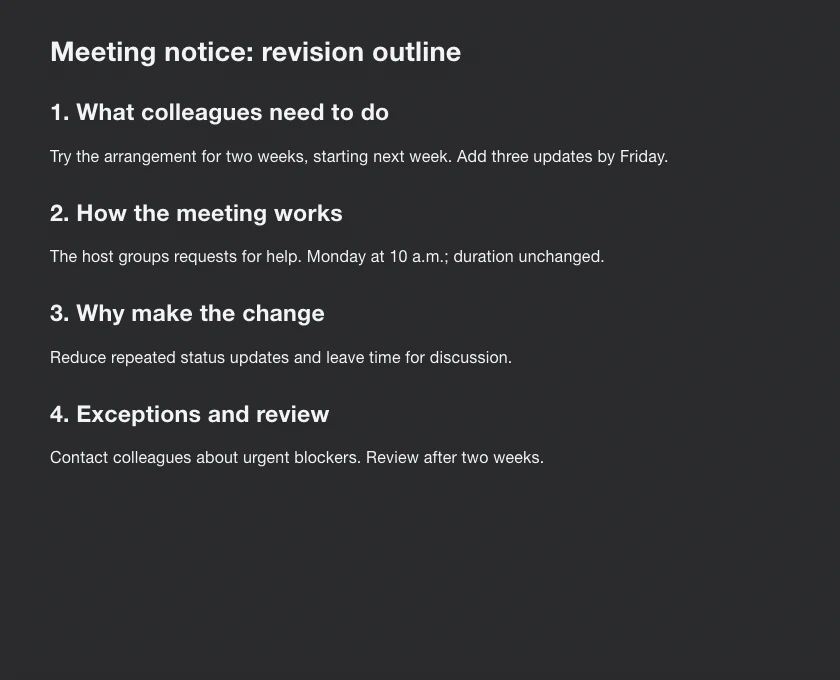
In a revision copy in Textend, give those four questions visible section headings and place the relevant sentences beneath them. The headings are temporary scaffolding: the short finished notice can return to four ordinary paragraphs. You do not need source mode or typed Markdown marks.
The screenshot shows that working outline. Put the question and essential information in each section, check for gaps, then turn it into the notice. This separates an unresolved order from a sentence that still needs better wording.
Turn the outline into a readable notice
The outline can become the notice below. Readers get the action first, then the organization and rationale. Urgent handling and review remain. The revision rearranges the supplied information without adding commitments or rules for the team.
When comparing it with the draft, check details that shortening could lose: starting next week, a two-week trial, the Friday deadline before each meeting, three updates in the shared document, and Monday at 10 a.m. with unchanged duration. They define what colleagues must do; a shorter sentence is not a reason to remove them.
Revised notice | Preparing for next week’s meeting
Starting next week, we will try written updates before the meeting and discussion during it for two weeks. By the end of the Friday before each meeting, add three items to the shared document: completed work, priorities for the following week, and help needed.
The host will group requests for help before Monday’s meeting. We will use the meeting to discuss blockers and decisions that need input. It will remain at 10 a.m. on Monday, with the same duration.
The change responds to recent meetings that repeated status information already in writing and left discussion until the end. We want people to read the updates beforehand and use meeting time to work through issues together.
Contact the relevant colleagues promptly about urgent blockers rather than waiting for the meeting. After two weeks, we will decide whether to continue based on everyone’s feedback.
Repair the joins and tone after fixing the order
After moving material, inspect references and transitions. In the original, “the arrangement” appears before the arrangement is explained. The revision names written updates and meeting discussion first, giving later references something concrete to point to.
Then check repetition. Paragraph one describes repeated status updates, while paragraph three explains not having to hear them again. Combining them gives the rationale one place and leaves room for actions and roles. Cut overlapping information rather than trying to make every paragraph equally long.
Finally, check whether the meaning changed. Wanting more discussion time is an intention; having improved meeting efficiency is a result. The draft supplies the intention only, so the revision cannot claim the result. Nor can a two-week trial become a permanent policy through polishing.
Work through this pass in Textend
Save the original and create a separate revision document containing the text you want to organize. Make sections for the four questions, note each paragraph’s job, and put its sentences in the appropriate section. Open the outline from View when you need to inspect the overall order or navigate by heading.
The job labels are temporary editorial notes you write yourself, not a special tagging system to learn. Once the structure works, remove the working headings and private notes, leave the notice as ordinary paragraphs, and read the finished text. Keep the current copy before trying another order so you can compare it later.
If you already use AI in Textend, you can ask it to describe each paragraph’s job, identify repetition and gaps, and leave the text and facts unchanged. Treat the analysis as another opinion before deciding on the order. Your first attempt can be completed entirely through your own labeling and rearrangement.
Try a small structural pass on the next draft
Choose a short draft that feels unclear and work on four or five paragraphs. State the reader’s question and label each paragraph’s job. Address one obvious problem first: an answer arriving late, repeated reasons, or too many jobs in one paragraph. After that change, decide whether more is needed.
This sequence suits explanations, notices, and instructions. Essays may deliberately delay an answer or dwell on a memory. Labels can still reveal the arrangement without requiring every piece to lead with the answer. Keep a choice when you can explain what it gives the reader.
- State what the reader needs to do or understand.
- Inspect paragraph jobs, then order, repetition, and gaps.
- Compare with the original, preserve facts and conditions, then polish.