 Textend
How do you turn a pile of notes into a first draft?
Work through six source notes: choose a reader question, arrange the material, fill a gap, draft one section, then return to the opening. Includes a complete Textend practice pack and a reusable template.
Start with these six notes
You have a notice, some rules, a process description, and a few loose observations, but the first paragraph will not come. Put the opening aside for now and ask what each note can help a reader understand. Once you have a readable section, return to how the article should begin.
We will use six notes about a community swap for a complete exercise. All event details are invented for teaching, not an actual event announcement. Your task is to explain to first-time participants what to prepare and how to take part.
We are starting before there is a draft. You do not need a polished introduction or a place in the article for every note. Keep the note IDs below so you can trace each piece of information when arranging it.
| Note and source | What it says |
|---|---|
| N1 | Current event notice | Saturday, 2–4 p.m., in the community hall. |
| N2 | Current item rules | Each person may bring up to 5 clean, usable books or stationery items. |
| N3 | Exchange instructions | Volunteers check the items. Each accepted item earns one token; one token can be exchanged for one item in the swap area. |
| N4 | Closing arrangements | The event ends at 4 p.m. Participants take home any of their items that have not been taken before leaving. |
| N5 | Old poster | Says “Books only.” Superseded by the current rules in N2. |
| N6 | Setup notes | Bunting at the entrance and old books used for display on the tables. |
Choose one question the article should answer
“Introduce the swap” can grow in many directions: the venue, its purpose, decorations, or its history. Your reader first needs to know whether they can take part, what to bring, and what to do on arrival. Put a specific question at the top of the working draft.
That question gives you a way to choose. N2 and N3 directly explain the conditions and steps for taking part, so they belong in the article. The bunting may be interesting, but it does not help a newcomer prepare. Leaving it out lets this piece stay focused.
Create a document in Textend and write the reader and question directly. Put useful notes underneath, then organize them with headings, paragraphs, and lists in the writing view. There is no need to switch to Markdown source.
Reader: someone attending the swap for the first time.
Question: what should they prepare, and how do they take part?
Arrange three sections around the reader’s visit
Write section headings that name what belongs in them, then place the notes underneath. Here, “before leaving home → on arrival → before leaving the venue” follows the reader’s actions. A product review or reading response may need a different order; choose it around that article’s question.
At this stage, note IDs and short reminders are enough. Park N1’s time and place under arrival for now, then consider moving them into the opening later. N2 supports preparation, N3 the exchange process, and N4 the closing instructions. Each section now has something concrete to work from.
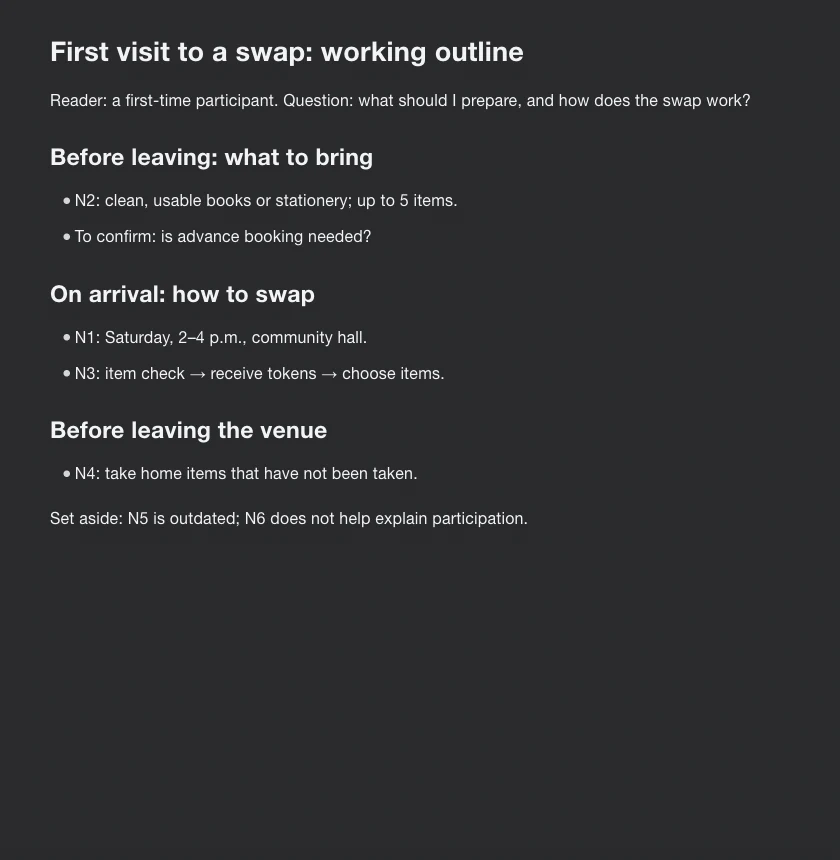
Make the questions into section headings and Textend’s document outline can show the structure. Jump to the section you are working on, then return to another to check how they fit. The working outline below still contains one question that needs confirmation.
- Before leaving: use N2 for item types, condition, and the limit.
- On arrival: use N1 and N3 for the location and steps.
- Before leaving the venue: use N4 for taking unswapped items home.
Mark the gap and set aside outdated material
While outlining preparation, you notice that none of the notes says whether advance booking is needed. Write “To confirm: is advance booking needed?” and note who can answer. Without it, a reader might prepare their items but still not know whether they can simply turn up.
To continue the exercise, we add N7 as information confirmed by the fictional organizer: no advance booking is needed, and participants register on arrival. Record it with the notes before using it in the draft. A plausible guess should not silently become an event rule.
N5 needs a decision too. Its “Books only” instruction has been replaced by N2, which allows books and stationery. Do not combine both versions. Set the old poster aside with a note explaining why it is outdated. Keep N6 for another piece that might need a description of the setting.
Draft the section you know best
The easiest section here is “Before leaving: prepare your items.” Its source is clear and it does not depend on the later sections. Turn N2 from a note into instructions addressed to the reader. The paragraph below is enough to begin the draft.
The paragraph adds useful actions—choose items and check them—without inventing fees, packaging rules, or booking requirements. Turning notes into prose requires explanation and connections. New rules and factual claims still need support.
After this section, use N3 to draft the arrival process and N4 for the departure reminder. If a passage stalls, leave a precise reminder such as “Add an explanation of how tokens work,” then continue with another section.
The first paragraph to draft
Bring up to 5 clean, usable books or stationery items. Choose what you want to swap, check each item’s condition, and stay within the five-item limit.
Return to the opening once the body exists
With preparation, exchange, and departure sections drafted, the opening has a clear job: tell a newcomer when and where the event is and whether they can turn up. Bring N1 and the confirmed N7 forward, leaving the sections to explain the actions.
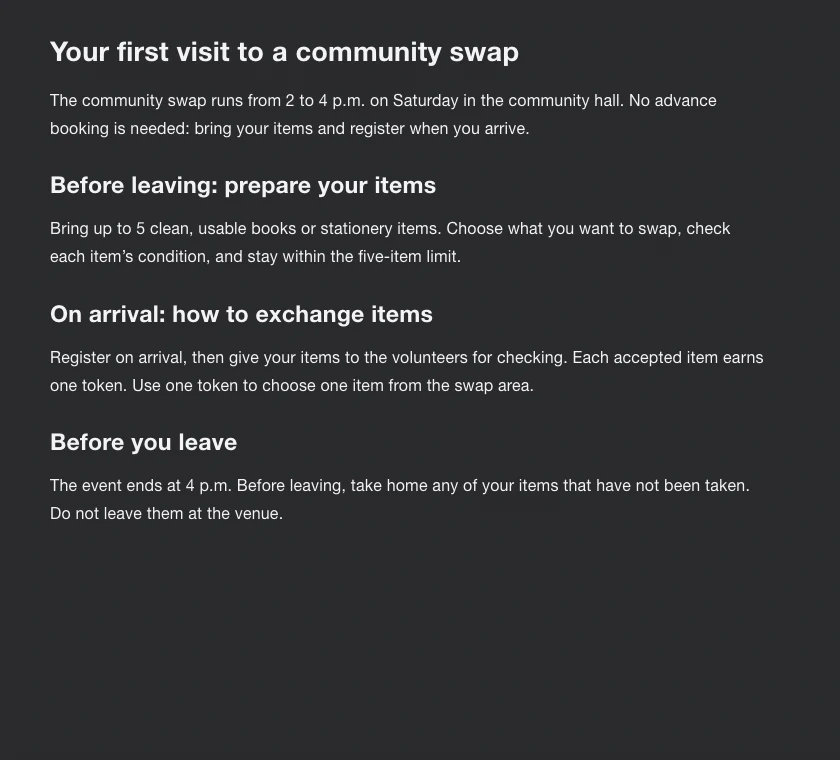
Read the four paragraphs together and check whether each prepares the reader for the next. Here is the body of the completed first draft. The downloadable .md file and screenshot retain the three section headings for navigation and further revision.
The first draft now answers the chosen question and states the practical arrangements. You can revise wording or remove repetition without having to start again at “What am I trying to write?”
First-draft text: your first visit to a community swap
The community swap runs from 2 to 4 p.m. on Saturday in the community hall. No advance booking is needed: bring your items and register when you arrive.
Bring up to 5 clean, usable books or stationery items. Choose what you want to swap, check each item’s condition, and stay within the five-item limit.
Register on arrival, then give your items to the volunteers for checking. Each accepted item earns one token. Use one token to choose one item from the swap area.
The event ends at 4 p.m. Before leaving, take home any of your items that have not been taken. Do not leave them at the venue.
If you use AI, ask what a reader would still need to know
You can complete the process yourself. If you want AI help, give it the notes, the reader, and the article’s question, then ask what is missing. Advance booking is a useful question here; the color of the bunting does not affect participation.
In Textend, start in Free discussion. Put the notes in a document and attach the current document, or send selected text as a quotation. Discuss the structure and gaps, then choose which suggestions to use. New AI tasks require Pro or an active trial and a configured AI service; this writing exercise works without AI.
Use the request below as a starting point. Judge the questions it returns: do they matter to this reader, can the notes answer them, and who can confirm what is missing? Keep unsupported points marked until you have the information.
The reader is attending the swap for the first time. Using only the attached notes,
list 3 questions the reader may still ask. Say which notes answer each question,
and mark unanswered ones for confirmation. Do not invent event rules or draft the article.
Use your own notes to draft one section
Download the practice pack to open the notes, outline, and first draft directly in Textend and compare the stages. A separate blank template lets you use the process for an explanation, a reflection on an experience, or a reading response.
Choose five or six notes you already have. State who the article is for and what it should answer, then make two or three headings that name the content. Place the notes under them and draft the section you know best. Where the material is insufficient, keep the question visible and confirm it rather than rushing to fill the gap.
You now have a draft to continue: the notes have places, the gaps are visible, and at least one section is prose. Returning to the opening or revising the paragraph order becomes easier when there is actual text to work with.